


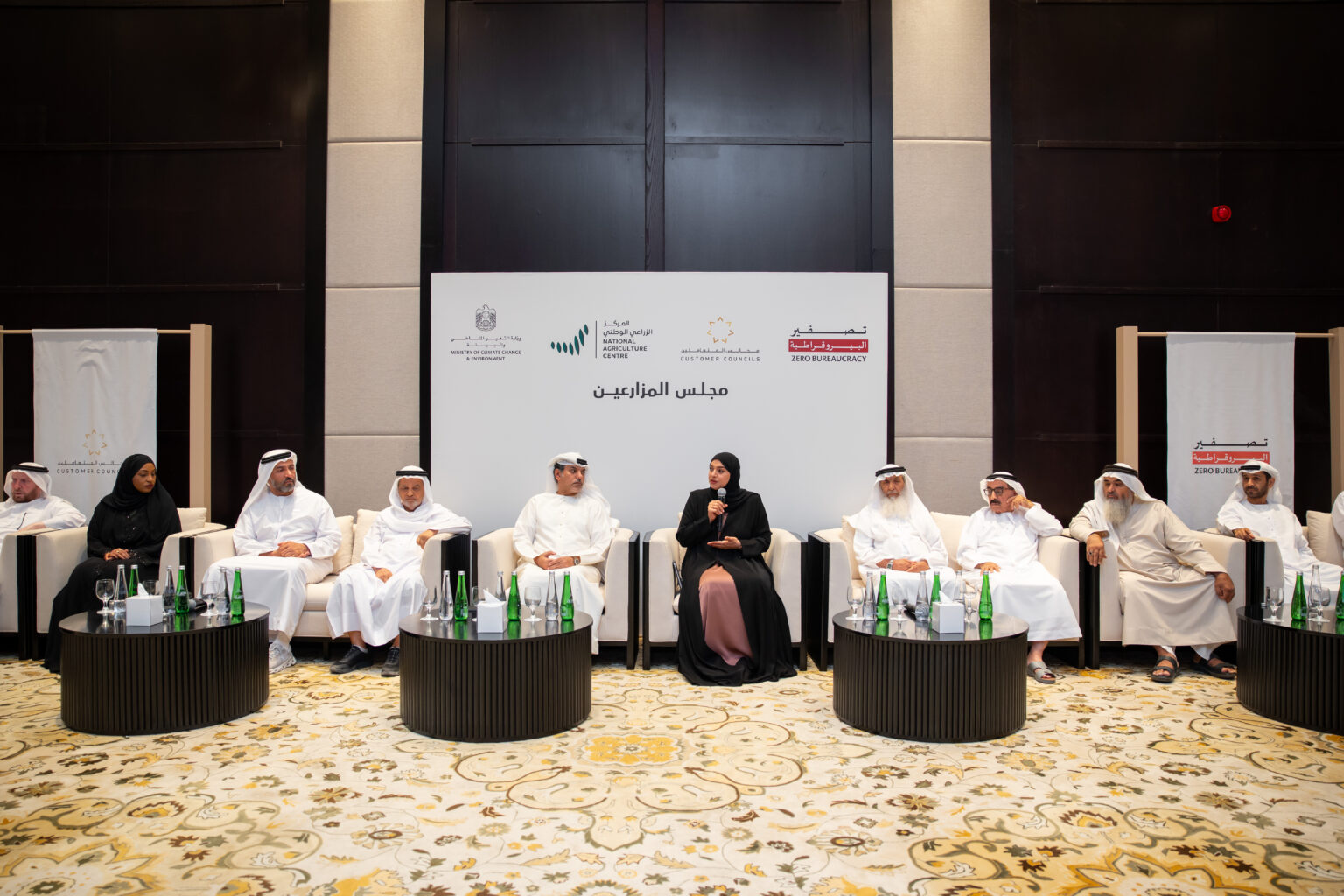
RAS AL KHAIMAH, 25th October, 2026 (WAM) — Dr. Amna bint Abdullah Al Dahak, Minister of Climate Change and Environment, chaired the Farmers’ Council in Ras Al Khaimah as part of the Customer Councils held under the Zero Government Bureaucracy Programme.
The Council engaged farmers in improving agricultural services and simplifying the procedures relevant to their work, while exploring ways to strengthen domestic production and expand market access for their crops. The interactive session addressed farmers’ needs and discussed proposals for better agricultural extension services and technical support, wider adoption of modern technologies, and stronger links between production, markets and the food processing industry. These efforts aim to support the UAE’s agricultural sector and strengthen its contribution to national food security.
The Council forms part of the efforts by the Ministry of Climate Change and Environment and the National Agriculture Centre to support the goals of the Zero Government Bureaucracy Programme. By listening to farmers’ experiences of using the Ministry’s services and the challenges they face, the Ministry can draw on their feedback to simplify procedures and reduce the time and effort needed to access services. The Council also helps shape farmer support programmes around practical needs and field experience, connecting service improvements with production and marketing requirements.
During the Council, Dr. Amna Al Dahak emphasised the important role farmers have played in supporting the national food system by helping meet local market needs. She noted that strengthening this contribution requires continued support for farms across the UAE, improvements in the quality of their produce, and closer alignment of production with national needs and market opportunities.
She noted that developing agricultural services and programmes is an ongoing process informed by farmers’ feedback and experiences, helping improve agricultural extension and support systems and shape projects and initiatives. She stressed that work continues to address the challenges farmers raise, and that agricultural initiatives require time, follow-up and continuous improvement to deliver their intended benefits. These efforts also seek to extend support to as many farmers as possible, taking into account their farms’ needs, crop types, production volumes and contribution to national food production.
She outlined the efforts of the Ministry and the National Agriculture Centre to expand market opportunities for locally grown crops by developing collection centres and private sector partnerships, including cooperation with leading food processing companies. She noted that these efforts aim to help farmers bring their produce to market and access sales channels offering competitive prices and attractive returns, while refining collection and marketing arrangements based on participating farmers’ experiences and feedback.
She stressed the importance of expanding the presence of Emirati produce across supply chains, including hospitality, food processing and retail. She noted that the success of these partnerships also depends on farmers’ participation and their commitment to supplying produce and meeting partners’ needs. This helps build successful partnerships that encourage more companies to work with UAE farms, creating broader and more sustainable market opportunities for local produce.
The event was attended by Mohammed Saeed Al Nuaimi, Undersecretary of the Ministry of Climate Change and Environment; Dr Mohammed Salman Al Hammadi, Assistant Undersecretary for the Food Diversity Sector; and Sultan Salem Al Shamsi, Director-General of the National Agriculture Centre, with around 30 farmers.
Improving Services with Farmers’ Input
The Council gave farmers an opportunity to ask questions, share feedback on the services they use and discuss their needs directly with Ministry officials. It also helped clarify matters relating to technical and advisory support and the procedures relevant to their operations. Discussions focused on using this feedback to improve services, make them easier to access and clarify their requirements, so that farmers have a simpler, clearer experience.
Participants discussed the importance of agricultural extension services tailored to different farms and crops, helping farmers make better decisions on irrigation, crop management and pest control and apply modern practices in their day-to-day work. Discussions also explored ways to strengthen communication with farmers, follow up on their needs and make information and services more accessible to support continuity of production.
The Council examined the factors that shape a successful growing season, including input costs, water availability and efficient use, crop protection and quality, loss reduction and market access. Direct dialogue helped clarify farmers’ needs in these areas and explore solutions suited to their farms.
Marketing locally grown crops was a central focus. Discussions examined ways to expand their presence across retail outlets and distribution channels and build closer connections between farmers, buyers and food companies. Participants highlighted the importance of aligning agricultural production with market demand, helping farmers plan their seasons and secure sales at returns that encourage expansion and investment.
The Farmers’ Council also explored opportunities to connect farmers with the food processing industry and use local crops in a wider range of processed food products. This would broaden demand and add value to locally grown crops. Such links can support the development of the agricultural value chain, from production through sorting, packaging, storage, processing and marketing, creating wider economic opportunities for farmers and partners while reducing losses and making better use of farm output.
The Council addressed the future of agricultural production and opportunities to expand the use of modern technologies and sustainable practices, particularly to improve the efficiency of irrigation and input use, raise crop quality and reduce losses. The dialogue highlighted the importance of technologies that suit farmers’ needs and are economically viable, supported by agricultural advice, training and technical assistance.
This approach supports more efficient farms that can adapt to climate and water pressures and changing market conditions. It also strengthens the resilience of the agricultural sector, supports sustainable production and conserves the resources on which its future growth depends.
Farmers shared their experiences in production and marketing and the challenges of managing their farms. Their feedback covered advisory and technical support, improving crop quality, reducing production costs and expanding sales opportunities. They also discussed adopting technologies suited to their farms and available resources, helping them earn returns that support continued farming and further development of their production.
The Ministry said farmers’ participation in these councils helps set priorities for improving services and support programmes and enables their proposals and needs to be followed up in coordination with the relevant authorities. Drawing on farmers’ own experiences, this participation supports efforts to eliminate bureaucracy and links better services with the growth and advancement of farms in the UAE. It also helps create more opportunities for younger generations to pursue careers in agriculture and food innovation.
Source: Emirates News Agency
