


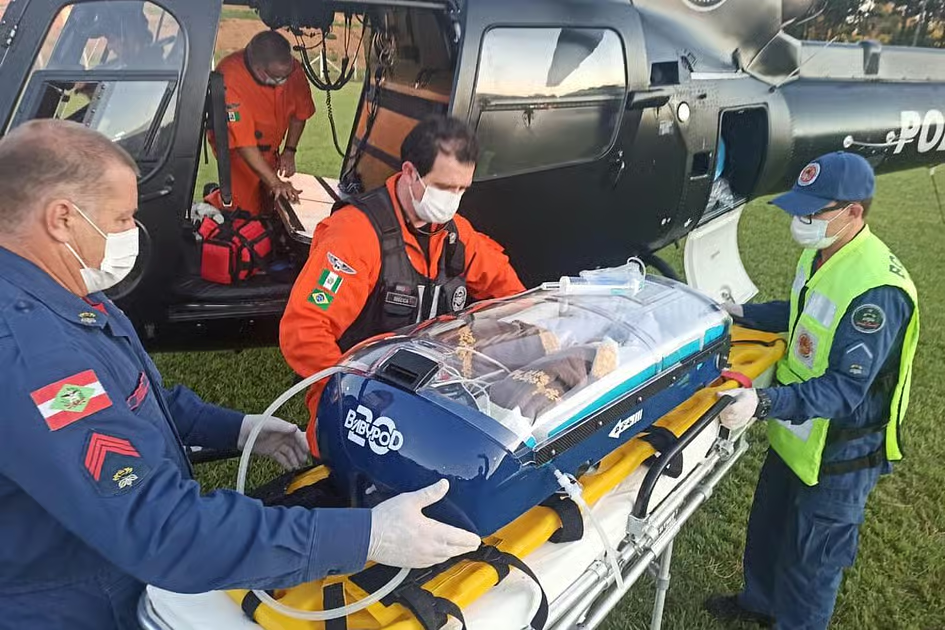
Inside an air ambulance, there is little room for error. A baby who needs intensive care must be moved between hospital beds, ambulances and aircraft without losing the medical support keeping them stable. A breathing tube can become dislodged, body temperature can drop rapidly and a patient’s condition can deteriorate before the journey is over.
For specialist retrieval teams, the challenge is to make the journey an extension of the intensive-care unit, with doctors and equipment ready to respond if a patient takes a turn for the worse.
“The level of care should not fall simply because the patient is moving,” said Dr Jon Barratt, consultant in emergency medicine and pre-hospital emergency medicine, and group director of pre-hospital emergency care services at Burjeel Holdings.
Stay up to date with the latest news. Follow KT on WhatsApp Channels.
Such transfers can be necessary when a hospital does not have the specialist services a patient needs, including neonatal or paediatric intensive care, paediatric cardiac surgery, neonatal surgery or extracorporeal membrane oxygenation (ECMO), which temporarily supports heart and lung function. Some patients also need to travel overseas for highly specialised treatment or to return home after receiving care elsewhere.
The reasons range from extreme prematurity and congenital heart conditions to babies requiring cooling after birth asphyxia, surgical emergencies, severe respiratory failure, sepsis and major trauma in older children.
When the journey becomes part of intensive care
Transporting a critically ill child presents risks that go beyond the distance travelled. Babies have limited physiological reserves and can lose heat, oxygen and blood sugar quickly. Their small airways also make breathing tubes vulnerable to displacement as they are transferred between a hospital bed, road ambulance and aircraft.
Even in a pressurised cabin, oxygen availability is reduced, while trapped gas can expand. This can be significant for patients with a collapsed lung or a distended bowel. Noise, vibration and restricted space add further challenges, particularly for premature infants.
The medical team must therefore anticipate complications before departure and have the expertise and equipment to treat them en route.
Depending on the patient’s condition, this can include advanced ventilation, high-frequency oscillation to support breathing, inhaled nitric oxide, medicines to support blood pressure, active cooling, invasive monitoring and emergency airway management.
“Deterioration can occur during transfer, so the team must be able to treat it rather than simply observe it,” Barratt said.
For some patients who cannot maintain adequate oxygen levels despite intensive treatment, conventional support may not be enough. In selected cases, specialist teams can initiate ECMO at the referring hospital and transport the patient while the circuit supports heart and lung function. The decision depends on the patient’s condition and suitability for treatment, as well as the availability of a receiving centre equipped to continue care.
“ECMO capability also depends on a complete system of surgeons, perfusionists, and a receiving unit, not simply the aircraft,” Barratt said.
From the UAE to Europe
The need for specialist transfers is illustrated by a case handled by ICATT Response Plus, involving a young boy with congenital laryngeal atresia — a rare condition affecting the airway — and a history of multiple upper-airway surgeries.
The team transferred the child from the UAE to Europe for specialist care, according to the company. “The boy had a complex medical history and required specialist care, prompting the transfer from the UAE to Europe,” said Satish Munoli, CEO of ICATT Response Plus.
ICATT Response Plus, a joint venture between ICATT Air Ambulance and RPM, launched its neonatal and paediatric transfer service in the UAE in March. The company says it has stationed a specialist team and equipment in the country to support transfers of critically ill babies and children.
Its wider operations in India have experience with neonatal transfers and ECMO, while the UAE service is intended to provide specialist medical support for patients who need to be moved between hospitals locally or internationally.
A smaller pod for the smallest patients
Moving a newborn adds another challenge: keeping the baby secure and maintaining the right environment while changing vehicles or aircraft.
One piece of equipment introduced by ICATT Response Plus is the BabyPod 2, a lightweight neonatal transport pod designed for infants weighing between 2kg and 8kg. Weighing approximately 9.2kg, it is designed to be secured in aircraft, helicopters and road ambulances.
The pod can help simplify transfers between vehicles and reduce the need to handle an infant repeatedly. It is X-ray translucent and CT-compatible, according to the manufacturer, but is not MRI-compatible. ICATT Response Plus said the device has not yet been used for a neonatal transfer by its UAE operation.
The pod is not a complete replacement for a conventional transport incubator. Barratt said incubators offer important advantages, including a heated and often humidified environment for premature babies, and the ability to integrate equipment such as ventilators, monitoring systems and suction.
With a pod, some of that equipment may need to be carried and secured separately. Published outcome data for neonatal pods are also still emerging, he explained.
Ultimately, the equipment and medical team must be matched to the patient. The aim is not simply to get a critically ill child to another hospital, but to ensure that the care needed to keep the child stable continues throughout the journey.
Source: Khaleej Times
