


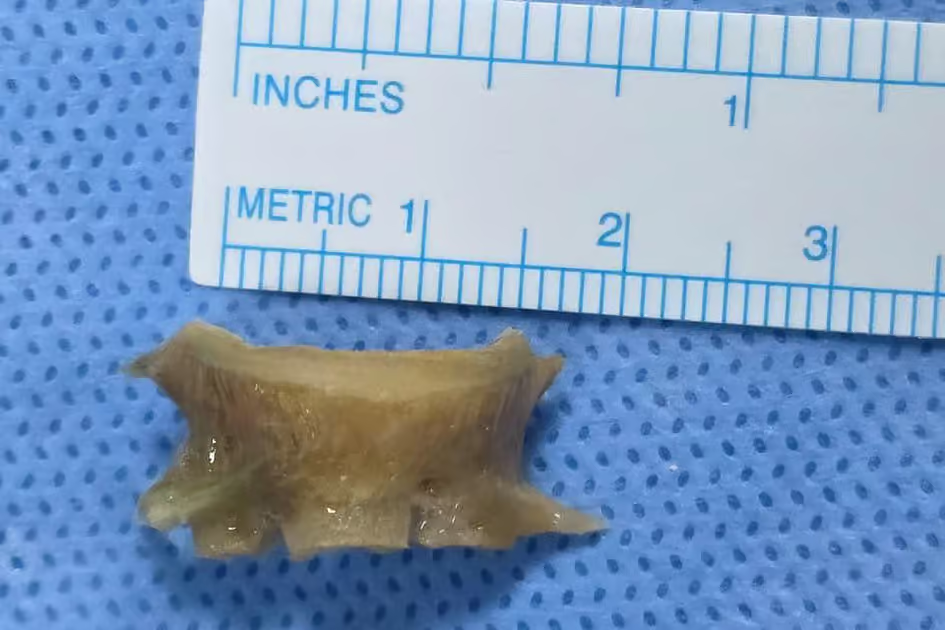
A fish bone he accidentally inhaled while eating continued to affect a Sharjah man’s breathing for almost two months before doctors found it lodged in the airway, leading to his right lung.
Unnikrishnan Sivaraman, 60, said he swallowed a milkfish bone on July 1. Soon afterwards, he felt uneasy, became nauseous and vomited blood. He went to the emergency department at Aster Hospital in Al Qusais.
But the problem did not end there. Sivaraman continued to have a cough and chest congestion and found it increasingly difficult to breathe. He sought further medical advice.
A CT scan at another hospital eventually showed that the bone was stuck in his lower airway. He was referred back to Aster Hospital Al Qusais and then to Aster Hospital Mankhool for treatment.
Stay up to date with the latest news. Follow KT on WhatsApp Channels.
Doctors there confirmed that the nearly 2cm bone was lodged in his right main bronchus, the airway that carries air to the right lung. It had remained there for almost two months. In that time, inflammation and granulation tissue had formed around it.
The bone’s position and sharp edges made it risky to remove. Doctors said they had to consider the possibility of injuring the airway wall or nearby structures, causing bleeding, blocking the airway during the procedure or making it difficult to keep the patient’s oxygen levels stable.
Pulmonologist Dr Jolsana Augustine, ENT specialist Dr Bharath Neranki Satish Rao and anaesthetists Dr Abhishek Jayaprakash Narayan and Dr Siraj Madayi Meethel planned the procedure together.
On September 11, Augustine used a bronchoscope to move the bone from the right main bronchus towards the upper airway. Dr Rao then used forceps to extract it, taking care to protect the vocal cords. Doctors performed another bronchoscopy to check the airway and clear secretions.
“When a foreign body remains in the airway for a prolonged period, inflammation and granulation tissue can make removal more challenging,” said Augustine. The size, sharp edges and location of the bone required controlled movement, she added.
Dr Rao said the final stage was delicate because the bone was close to the vocal cords. He said that their aim was to remove it while protecting those structures.
Sivaraman was discharged within a few hours in stable condition. At a follow-up, he said his breathing had improved and that he needed no further treatment.
“I am very thankful to the doctors for the care and support I received,” he said. “I am very happy with my recovery and the significant improvement in my breathing and overall condition.”
Source: Khaleej Times
