


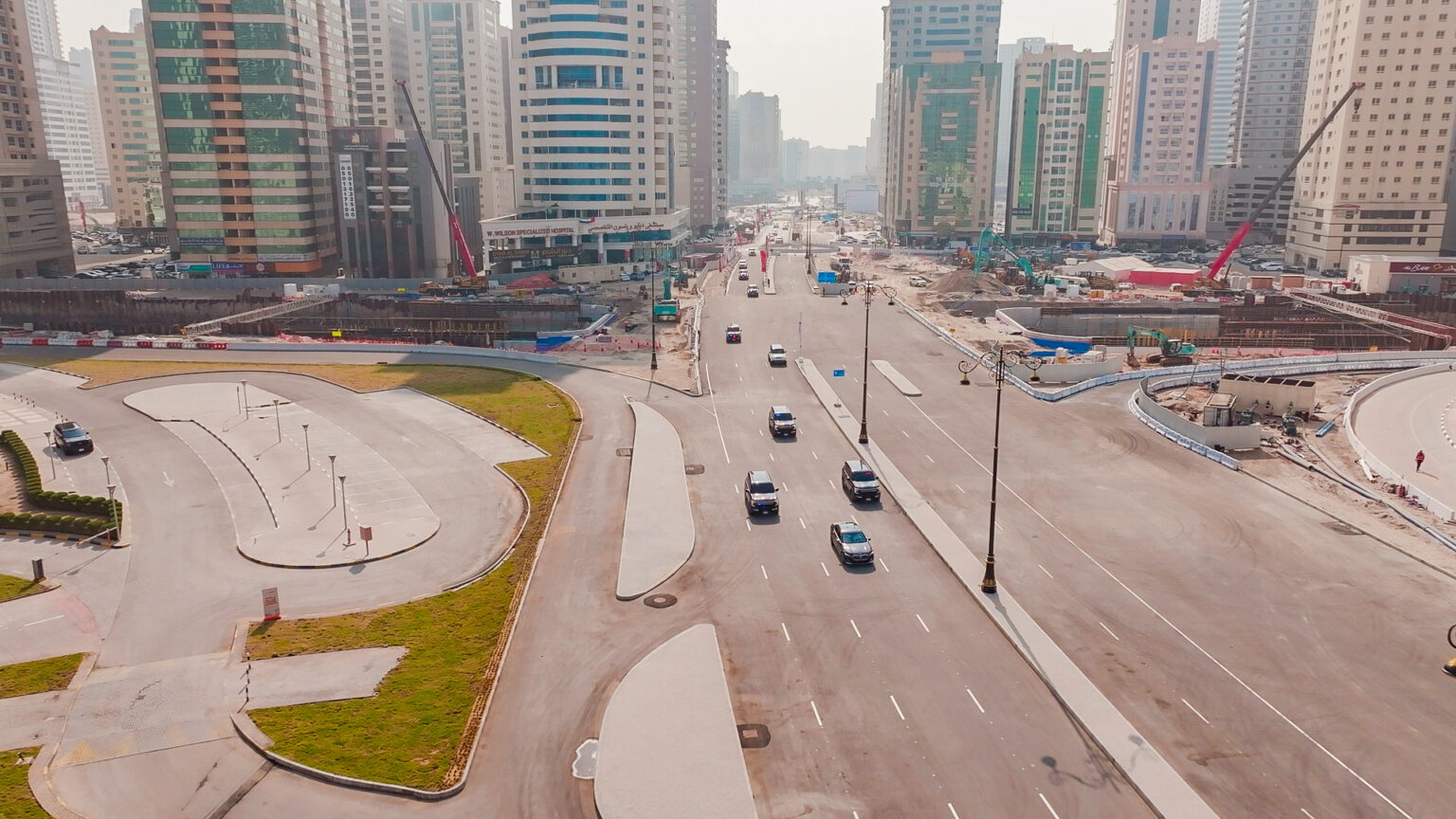
SHARJAH, 4th November, 2026 (WAM) — His Highness Sheikh Dr Sultan bin Mohammed Al Qasimi, Supreme Council Member and Ruler of Sharjah, inaugurated on Wednesday morning the first phase of a project to develop and construct new road links between Sharjah and Dubai, aimed at improving traffic flow and reducing congestion on routes connecting the two emirates.
Dr Salah bin Butti Al Muhairi, Chairman of the Initiatives Implementation Authority, “Mubadara”, explained that the first phase includes the partial opening of Al Taawun Interchange and the operation of several bridges and junctions, providing one-way traffic flow from Sheikh Mohamed bin Zayed Road towards Expo Centre Sharjah to facilitate access for visitors to the Sharjah International Book Fair (SIBF).
The second phase will include the full opening of the upper-level junction at Al Taawun Roundabout and Al Taawun Tunnel, the completion of bridges and junctions along the three industrial streets, and the development of Al Khulafa Al Rashideen Interchange and the bridge connecting it to Jamal Abdul Nasser Street, leading to the project’s full operation.
Al Muhairi praised the combined efforts and complementary roles of the entities involved in accelerating the completion of the first phase. He said the project directly improves the efficiency of the road network, facilitates smoother travel and reduces congestion by increasing capacity on key routes.
Dr Al Muhairi noted that these projects embody the vision and directives of His Highness the Ruler of Sharjah to establish integrated infrastructure that keeps pace with urban and economic growth and helps improve quality of life.
Eng. Yousef Khamis Al Othmani, Chairman of the Sharjah Roads and Transport Authority (SRTA), said the project’s opening follows the directives of His Highness the Ruler of Sharjah, which underpin efforts to develop the emirate’s road system.
“This vision places people, their needs and their quality of life at the heart of development. The works completed in the project’s first phase put this vision into practice by developing vital routes and junctions and strengthening their integration with service facilities, keeping pace with the emirate’s growth and supporting efficient travel,” he said.
Al Athmani added: “We extend our sincere thanks and appreciation to the Initiatives Implementation Authority and all relevant local and federal entities involved in these projects for their cooperation, combined efforts, support and coordination throughout the various stages of work.
“This institutional integration reflects an effective partnership that brings together expertise and resources to achieve development objectives and serve the emirate and its people. The value of these projects lies in their anticipated impact on people, families and their daily journeys, as well as the connectivity and efficiency they add to the road network.
“We are working continuously with our partners to complete the project to the highest standards of quality, precision, safety and sustainability, while accelerating progress to deliver infrastructure that serves present requirements and meets future needs.”
The project comprises five main sections. The first involves constructing Al Taawun Tunnel and Roundabout, including a 560-metre tunnel with three traffic lanes in each direction along Al Taawun Street towards Al Nahda Bridge and Dubai, together with a signal-controlled junction above the tunnel to regulate surface traffic.
The tunnel’s target capacity is approximately 4,200 vehicles during the peak hour. It will separate through traffic from local traffic, reduce congestion at Al Taawun junction and maintain continuous traffic flow towards Dubai, while facilitating access to Expo Centre Sharjah and surrounding areas.
The second section includes developing Al Khulafa Al Rashideen Interchange on Al Ittihad Road by constructing two box underpasses beneath the bridge to provide two additional traffic lanes in each direction. It also includes constructing a bridge approximately 315 metres long to connect the interchange to Jamal Abdul Nasser Street.
The works cover improvements to service roads and parking areas along Al Ittihad Road, while preserving open sightlines and avoiding obstruction of shopfronts, ensuring the continuity of commercial activities and easy access to surrounding premises.
These improvements are expected to add capacity for approximately 2,600 vehicles per hour across both directions and improve connections between Al Khan Street, the Ring Road and the main routes leading to Sheikh Mohamed bin Zayed Road.
The third section involves upgrading the two junctions intersecting First and Second Industrial Streets by creating a signal-controlled junction and providing two free-flow turning lanes before the traffic signals. It also includes two new bridges extending approximately 866 metres, with two lanes in each direction.
The new junction connects Damascus Street in Dubai with Wasit Street in Sharjah, with routes facilitating vehicle movement towards Mleiha Street and Sheikh Khalifa bin Zayed Street. This will reduce conflicts between traffic movements and strengthen direct connections between main roads.
The target capacity of these works is approximately 2,800 vehicles per hour during peak periods, helping ease congestion and improve traffic service levels in the area.
The fourth section involves creating a new road link at the Third Industrial Street junction, including two new bridges connecting the Ring Road to Al Khan Street and onward to Al Khulafa Al Rashideen Interchange. The bridges will serve traffic in both directions towards the industrial areas and Dubai.
This section also includes improvements to turning routes towards Mleiha Street, Sheikh Khalifa bin Zayed Street and Al Dhaid Road, with a total length of approximately 2.7 kilometres.
It further includes a vehicular underpass connecting traffic from the industrial areas to the Ring Road, providing free-flow routes in the main directions and reducing the need to stop at junctions.
This link is one of the project’s most significant additions, opening a new, direct route towards Sharjah city centre and strengthening connections between Port Khalid and the industrial areas. It will provide additional capacity estimated at approximately 5,200 vehicles per hour across both directions.
The fifth section involves upgrading the turning route from Sheikh Mohamed bin Zayed Road towards the Ring Road by increasing it to three traffic lanes.
It also includes widening the section of the Ring Road between Sheikh Mohamed bin Zayed Road and the junction intersecting Third Industrial Street. The widening will add two traffic lanes towards Sharjah city centre and one additional lane towards Sheikh Mohamed bin Zayed Road.
Entrances and exits will also be reorganised, and merging and diverging lanes will be improved, increasing road capacity and supporting smoother traffic flow between the new links and existing roads.
The total length of roads reached approximately 9.18 kilometres, with a paved area of 207,265 square metres. Bridge lengths totalled approximately 753 metres and tunnels 581 metres.
A stormwater drainage network extending approximately 19 kilometres was also installed in coordination with the relevant utility authorities to ensure service continuity and integrated infrastructure.
Once all phases are completed, the project is expected to transform Sharjah’s road network by providing new routes connecting residential, commercial and industrial areas to main roads and improving travel between Sharjah and Dubai.
Source: Emirates News Agency
