


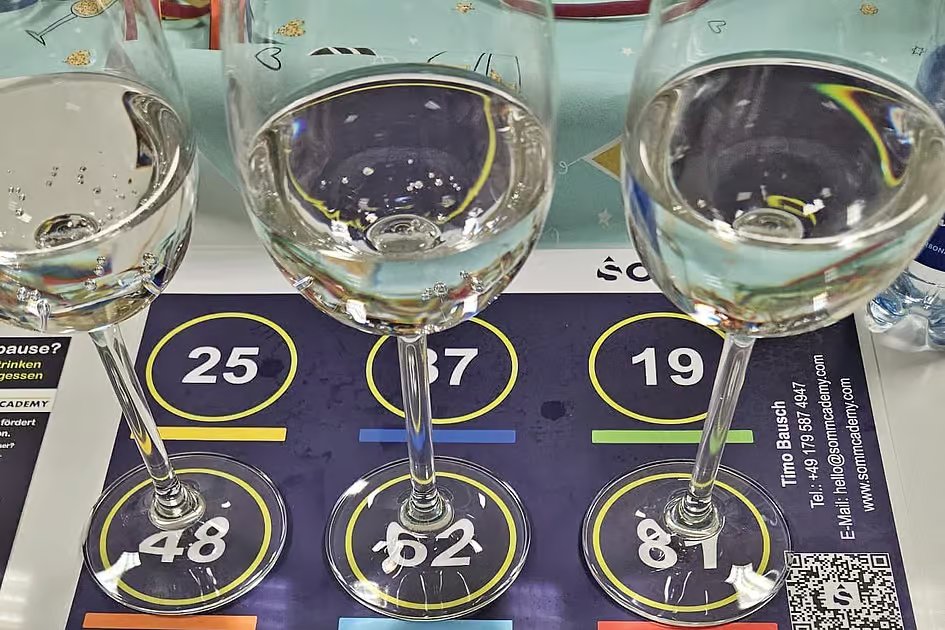
Water is tasteless, or so we were taught in school, but in the rarefied world of water tastings, water is metallic. Or bitter, depending on its minerality. And experiencing water’s spectrum of flavours at private water tastings is an emerging trend in the UAE. “Water tastings and water bars have become more popular across the globe,” says Dubai-based water sommelier Timo Bausch, who shifted to the city in December last year. Since then, he has conducted about six water tastings at corporate parties, friends’ get-togethers and a fan zone in Dubai during the 2026 FIFA World Cup.
Water sommeliers explain that there is a buzz of interest among people as they want to learn about water’s various characteristics — its origin, mineral composition, taste, the mouthfeel — with a curiosity that’s usually reserved for coffee and beverages. “And I think this is especially true in cities like Dubai where luxury is about creating memorable experiences, rather than just simply displaying something expensive,” explains Bausch. During our chat on Google Meet, he pulls up the gleaming bottles of water with the Emirates Quality Mark (EQM) — one look, and you know this is not something you want to drop. Bausch, who also sells natural mineral waters online, explains that a bottle of imported water costs anywhere between Dh9.50 and Dh40 on his online shop. “But in a fine dining restaurant, you will probably pay something like Dh80 or Dh90 for it,” he says. Prices vary considerably depending on the brand, its scarcity, where one consumes it and so on.
The allure of water tastings
Pat Eckert, a Germany-based water sommelier, CEO and founder of Fine Liquids, a supplier and retailer of bottled mineral waters, has worked with UAE-based clients through virtual water tastings. These include organisers of major corporate events, members of the royal family and globetrotters who developed a love for a particular water on one of their trips abroad, but can’t source it back home. “I get a lot of inquiries from the GCC,” he says. Eckert adds that water tastings’ rising popularity across the world could be attributed to two factors. “People are more aware of what good water really means,” he says. And secondly, there is a conscious shift away from alcoholic drinks or sugary cocktails, thus making such water tastings a great choice at events.
They also act as great conversation starters at events. Bausch says that people stroll over to his water bar, incredulous to hear that water can actually taste sour or bitter. “I usually start with water that is low in minerals as that’s what people are more familiar with,” he explains. “So when they take a sip of the first water, they cannot taste anything much. But when they drink the second water, they feel a big difference.” Even mocktails and coffee can taste different depending on the water that’s mixed in. “Sometimes, I pair different kinds of food with water to show how water affects its taste,” adds Bausch.
Allison Poerner, the first water sommelier in the GCC region and business owner, says that the trend is picking up “very, very slowly” in the Middle East. She, too, has organised water tastings for corporate events. “And because water is actually good, healthy and fun, you can do so much with it,” she points out.
Behind the scenes
So how exactly is a virtual water tasting held? Once clients select the type of virtual water tasting they want through the Fine Liquids website, Eckert explains that a ‘preparation video’ is sent to them. “We send the waters they’ve chosen directly to their place,” he adds. Before the tasting, he shares a few guidelines with them — the water has to be brought to room temperature at least 48 hours before the tasting, and participants must avoid having anything spicy an hour and coffee 10 minutes before the tasting. “And then, look for some wonderful glasses, because we want to celebrate it,” he says. They sample the water together, through a virtual call, facing each other.
The key in all his tastings, he says, is to “drink with awareness”. So, Eckert observes how quickly they swallow and guides them to slow down. “I look at which water to start with, what kind of stories I can tell about the source and what kind of health impact this water has.” He encourages people to pay attention to the water from that first sip, the sensations it creates as it makes its way around the mouth and the aftertaste, while helping them to appreciate the complexity in textures.
The chemistry of water
Back in Dubai, Bausch sources water from countries like Italy, Norway and Georgia. “Some clients look for very exclusive waters, which you cannot find in supermarkets,” he explains.
Science and geography are at play before the water is bottled. The type of region the water comes from matters, he says — for instance, water from a volcanic area in a European city will have more minerals and thus taste more intense, salty, or sweet. “And if you go towards the Scandinavian area where you don’t have that many mountains and the water is lower in minerals, then it’s usually bitter.”
“Rainwater seeps through the different layers of the ground,” he continues. “The lower and deeper it travels, the more time it has to absorb minerals, get richer in terms of minerality and taste more intense.” As Eckert puts it, super still water is “glacial water, which never saw the ground and never had the time to pick up minerals”, so once melted they taste “super empty”. Different minerals have their own taste: for instance, water that’s high in calcium is strong and can leave a dry mouth, while water that’s rich in magnesium can taste bitter.
But it’s also difficult to pin down the taste of water in exact terms as it’s quite subjective — for instance, some people find water that’s rich in bicarbonate “flat” while others describe it as “earthy” and “like breathing in a forest’,” says Eckert.
Poerner plans her water tastings depending on the event. “If it includes food, then I would choose a different water — for instance, something sparkling like a San Pellegrino is really good on the palate when you’re having a hot, spicy meal, because it kind of takes a bit of the burn away, but enhances the flavour at the same time.” She, too, starts off with a low-minerality water and then graduates to a medium, high and very high-minerality water. “And then, there is carbonated water, starting with effervescent carbonation, a little angel talking on your tongue, and moving on to larger bold carbonation, like Perrier water, just to elevate your experience.”
Bausch himself has about four different types of water throughout his day. “When I get up early in the morning, I drink water that’s high in minerals or electrolytes and during the day, I drink lower-mineralised water.” And post his workouts, it’s back to chugging water that’s high in minerals like calcium and magnesium.
Dubai resident Danyah Shafei opted for a water tasting by Bausch more than a month ago. “I’ve heard about water tastings but didn’t want to experience it alone. So when my friends visited me at home, I booked a one-hour session.” Initially, they couldn’t understand how water could taste different but as Bausch explained its history and composition, they finally got it. “It had thickness, it tasted sweet, and you could taste the minerals,” she says. “It was an amazing, and surprising, experience.”
Source: Khaleej Times
