


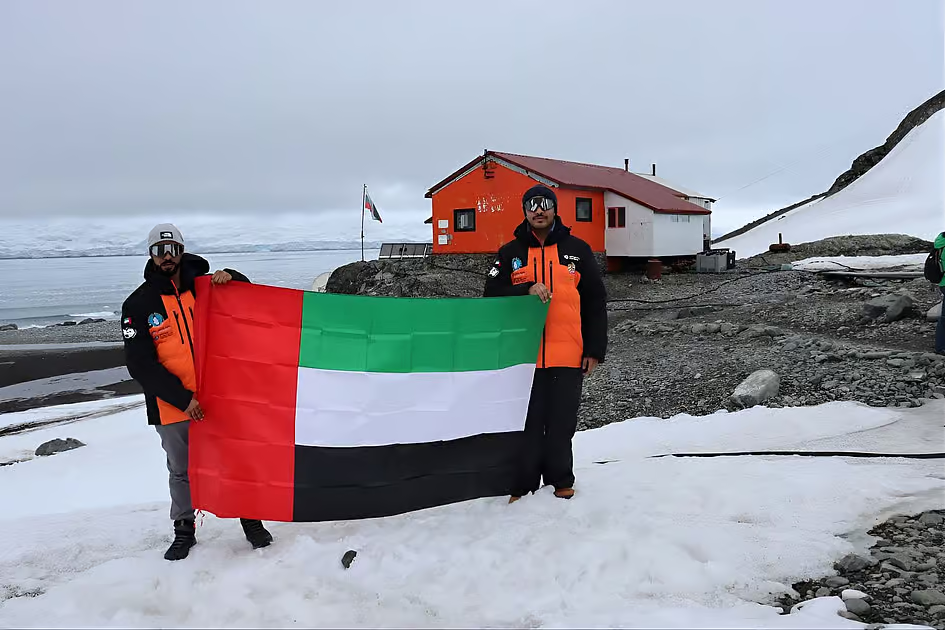
It may seem unlikely that a desert country would look to the world’s coldest regions for climate answers. But for UAE scientists, the Arctic and Antarctica are not distant frontiers. They are early warning systems for a changing planet.
Since the Emirates Polar Program was launched in 2023, UAE researchers have taken part in five expeditions across Antarctica and the Arctic, as the country expands its scientific work from the desert to ice sheets and glaciers.
The expeditions include field activities in Antarctica, Arctic research in Svalbard and the UAE’s first scientific expedition to Greenland in July 2026.
Stay up to date with the latest news. Follow KT on WhatsApp Channels.
So why is the UAE, the first Arab country to launch a national polar science programme, looking to the poles?
“Although the Arctic and Antarctica are geographically distant from the UAE, their influence extends to the whole planet. The polar regions help regulate Earth’s climate, oceans and weather systems, making them important to understanding environmental change globally,” Loulia AlKhatib, Researcher at the Emirates Polar Program, told Khaleej Times in an interview.
For the UAE, the programme is not just about studying distant ice sheets. It is about understanding how changes in the world’s coldest regions can affect sea levels, oceans, weather patterns and long-term climate risks, including those relevant to coastal countries such as the UAE.
AlKhatib said the Arctic and Antarctica are central to the Earth’s climate system. Changes in sea ice, glaciers, ocean temperatures and atmospheric conditions can influence weather patterns, ocean circulation and climate systems far beyond the polar regions.
“This is why polar research matters to countries everywhere. The climate system is interconnected, and data from the poles helps scientists better understand environmental change at a global scale,” she said.
Early warning system
According to AlKhatib, the polar regions serve as an early warning system for climate change.
Scientists study ice sheets, glaciers, ocean conditions and atmospheric processes to understand how the planet is changing over time.
This is particularly important for coastal cities. Recent scientific assessments show that the rate of global sea-level rise has doubled over the past three decades, reaching around 4.5mm per year today, according to AlKhatib.
“Polar change is not only a polar issue. It affects the global systems that shape weather, oceans, coastlines, biodiversity and long-term environmental stability,” AlKhatib said.
Understanding these changes is part of preparing responsibly for the future, she added.
Polar research helps generate the scientific knowledge needed to understand risks early, plan better, and contribute to global solutions.
Loulia Alkhatib, Researcher, Emirates Polar Program
What UAE researchers are studying
The Emirates Polar Program supports research in atmospheric science, climate change, ocean systems, cryosphere studies, environmental monitoring and meteorology.
Through the UAE’s participation in Antarctic expeditions with the Bulgarian Antarctic Institute, UAE researchers have supported work involving weather and seismic monitoring stations, as well as instruments that track atmospheric conditions, sea level, ice melt, and methane in permafrost and glacial sediments.
These activities, AlKhatib said, are helping the UAE contribute to a broader scientific understanding of polar environments and their links to global climate change.
Polar research also gives scientists access to data from regions that play an important role in shaping global climate, ocean and atmospheric systems. Studying these environments helps improve models used to understand weather patterns, ocean circulation and long-term environmental change.
Through polar research expeditions, the UAE is advancing its own scientific capabilities in areas such as meteorology, atmospheric science, ocean monitoring, Earth science and environmental research. Institutions including Khalifa University and the National Center of Meteorology are playing an important role in this work.
International cooperation is fundamental to polar science, and the Emirates Polar Program is built around it, combining field research with a widening network of formal agreements.
As the programme expands its partnerships and field research, AlKhatib said it is helping build national expertise while contributing to global efforts to better understand a changing planet.
Source: Khaleej Times
